Dryads
The dryad’s existence is tied to her tree; if the tree dies, so does she. This intense, symbiotic relationship can be interpreted as a powerful metaphor for self-reliance and an identity that is inherently personal and autonomous, challenging patriarchal or heteronormative narratives of dependency.
Hecate
She is often depicted with a pair of torches, symbolic of her role as a guide through the darkness, and is frequently accompanied by black dogs, who were considered sacred to her. Hecate is associated with those on the fringes of society, including, individuals and communities who have been historically marginalized or “othered,” such as the LGBTQ+ community. She is seen as a deity who helps these individuals find power and protection.
Medusa
Queer interpretations of the Medusa myth explore her as a symbol of agency, rage, and resistance against patriarchal control, with some interpretations focusing on her hybrid nature, the twisting of her hair, and her monstrous transformation as metaphors for queer identity. These views often re-centre the narrative on Medusa as a survivor of sexual violence, challenging the original myth’s portrayal of her as a monster punished for a crime.
Hera
Associated with the colour royal blue which represent her power, royalty, and stability as the Queen of the Gods. She is often depicted with blue attributes, such as blue eyes, blue eyebrows and is closely linked to the peacock. In keeping with my depiction of Zeus as an old rock god, she is a glamorous wife with hair extensions and Botox lips.
In the Iliad, it is mentioned that Hera was locked in a cage on Mount Olympus for a time after participating in a coup against Zeus. Here she is newly made, very pregnant with her faded rock god husband Zeus. She has hair extensions and Botox lips – obviously.
Ariadne
Queer readings also focus on the idea that Ariadne’s strength, cunning, and role in outsmarting the labyrinth can be seen as a metaphor for the challenges faced by marginalized groups. My Ariadne sculpture will focus on the maze rather than the princess.
Leto
Gave birth to twins Apollo and Artemis in an olive tree.
Pheme
In the Aeneid she moves across the earth— so tall that her head is hidden by the clouds— with wings and a massive body covered in feathers, eyes, ears, and mouths. She never sleeps, and perpetually spreads news and rumours. The trumpet symbolizes the loud, widespread, and far-reaching nature of the news she spreads.
Hecuba
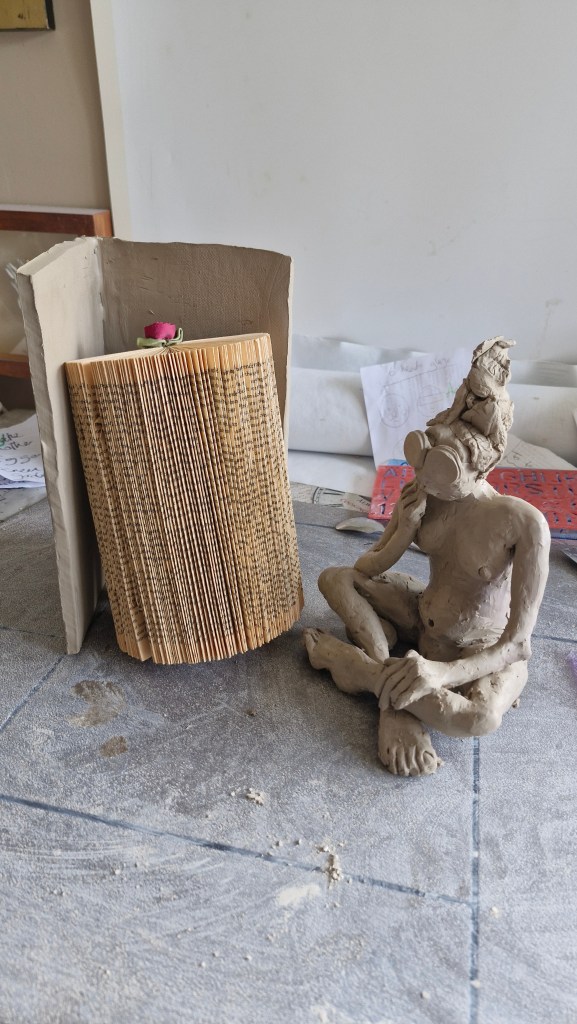
Hecuba, the Queen of Troy, suffered profound tragedy after the fall of her city. Enslaved by the Greeks and separated from her children, her fate varies depending on the legend one versions suggests that overwhelmed by grief and rage, Hecuba’s story concludes with a mythic transformation. Several accounts say she was turned into a fierce, howling dog by the gods so she could escape her captors. My Hecuba wears a dog mask and has a placid dog on her lap.
Clio
The goddess of books was the daughter of Zeus and Mnemosyne. She once mocked Aphrodite for her love affair with the mortal Adonis. In retaliation, Aphrodite caused Clio to fall deeply in love with Pierus.
Clio is traditionally depicted as a regal, inspiring figure surrounded by books and historical records. My Clio is reading a very large book entitled Cracked Myths which will sit at the front of the display of greek god/esses, monsters and buildings. The book inners will be attached to the ceramic cover once fired.


Leave a comment