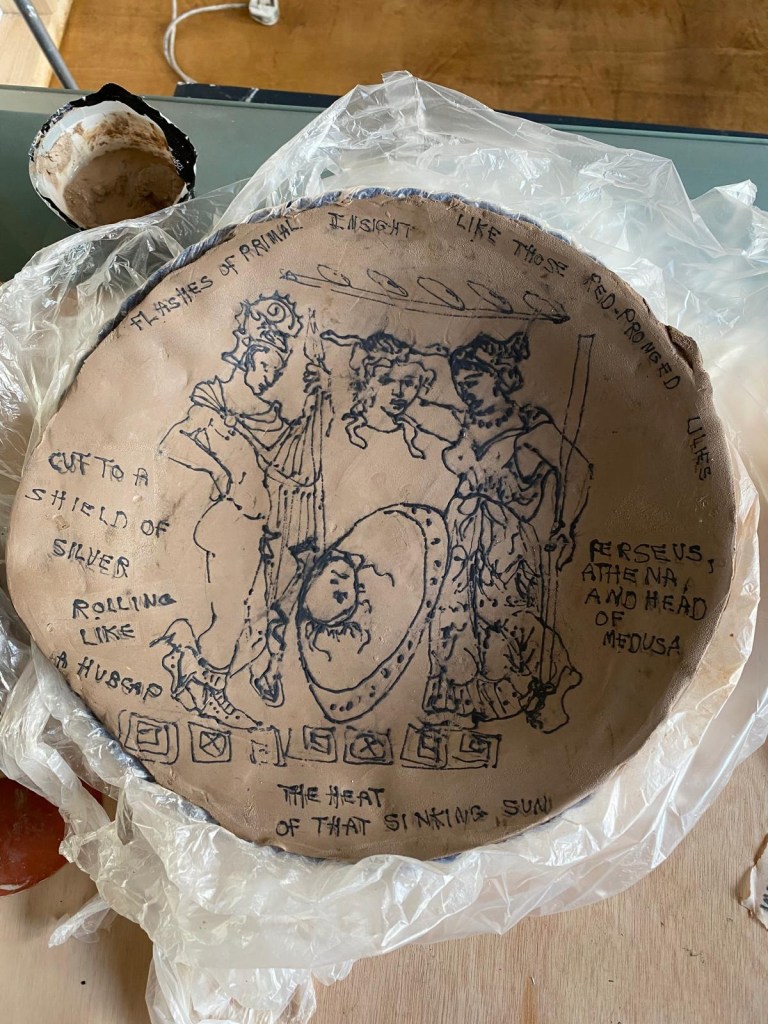
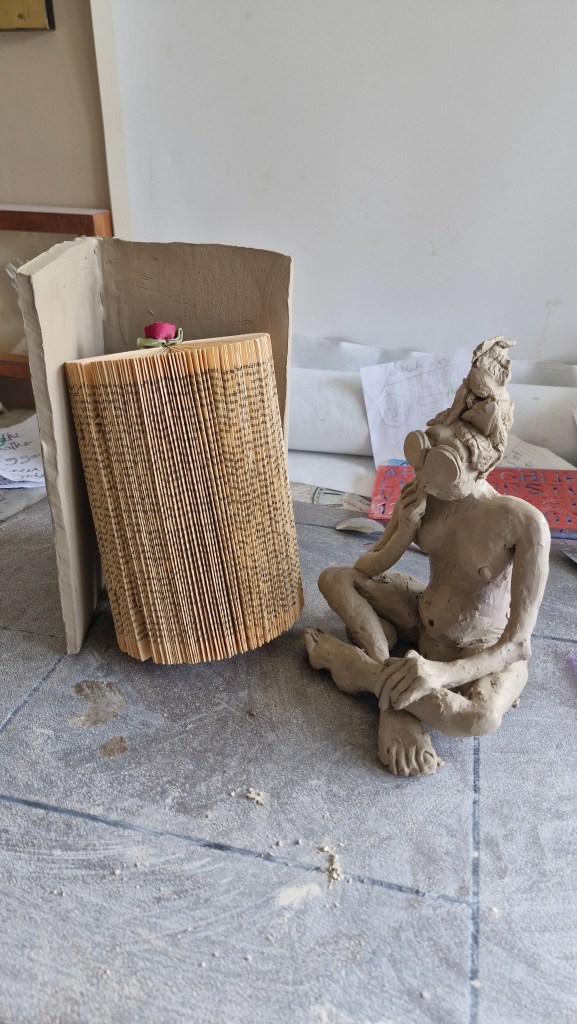
Paper pages will be attached to the inside of the ceramic book and a variety of Greek phrases will be written on them. These phrases were all derived from Ancient Greek stories, but they frequently used in the modern world.
Between a rock and a hard place – from the myth of Scylla and Charybdis in the Odyssey. When Odysseys wanted to sail through a narrow channel he was caught between Scylla the terrifying six-headed monster and Charybdis and giant sea monster who swallowed and spat out the ocean.
Echo Chamber – The nymph Echo fell in love with Narcissus but could never speak her own feelings, after a curse from Hera. She continually repeated his words back to home and wasted away in a cave until only her echoing voice remained.
Fatal flaw – Icarus flew too close to the sun
Flying too close to the sun – Icarus again
Sour grapes – from Aesop’s Fables. A hungry fox doesn’t manage to reach a bunch of grapes says he wasn’t interested anyway…
Carrying the weight of the world – Atlas was condemned to eternally hold up the heavens
Greeks bearing gifts – Trojan priest Laocoon warns his people about the deceptive Trojan Horse
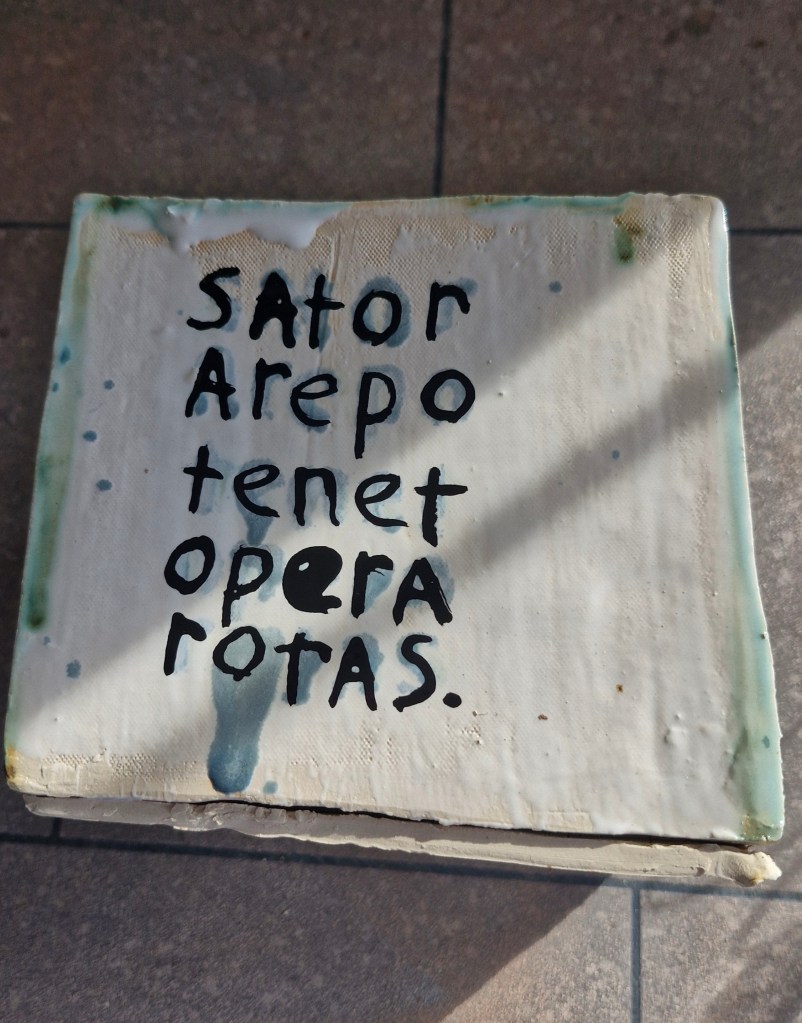
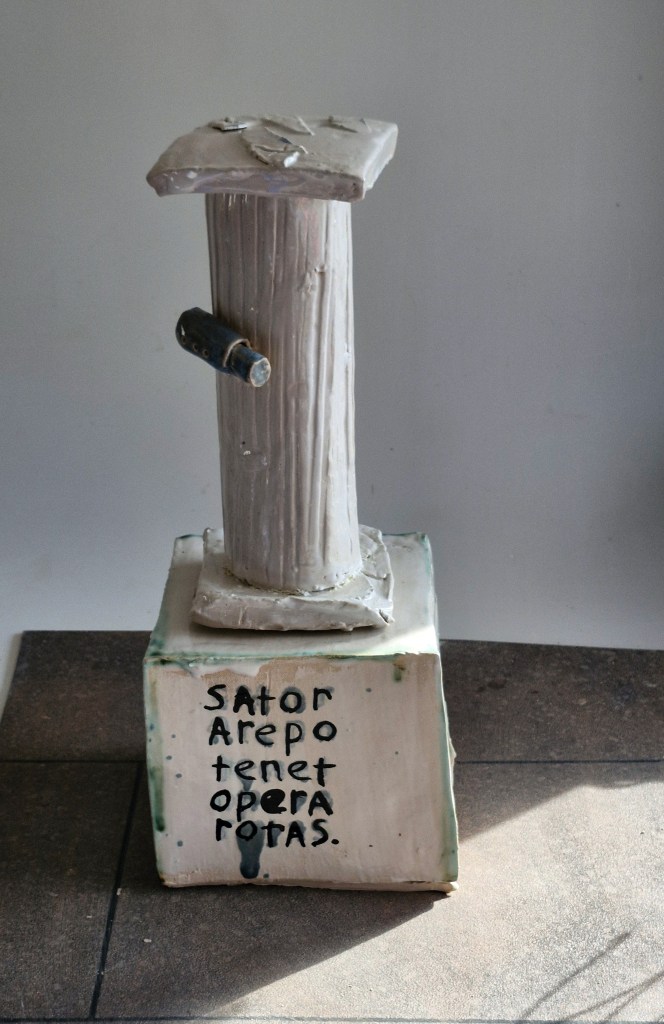
One of my big towers will stand on a SATOR square which is an ancient 5 by 5 Latin word grid.
This grid consists of five five-letter words: SATOR, AREPO, TENET, OPERA, and ROTAS.
Sator: Sower, planter, or creator
Arepo: Most likely a proper name or even an invented word
Tenet: Keeps
Opera: Work or endeavors
Rotas:Wheels or ploughs
When you read all these letters/words together as a sentence it means
“The sower Arepo holds/guides the wheels with care.”
History of the SATOR Square
The earliest versions date back before 62 CE and have been found in the ruins of Pompeii.During the Middle Ages, people used the square as a magical charm to ward off fires, thieves, sickness, and evil spirits. Early Christians rearranged the letters into a cross spelling out Pater Noster (Our Father) twice, with the leftover letters representing Alpha and Omega.
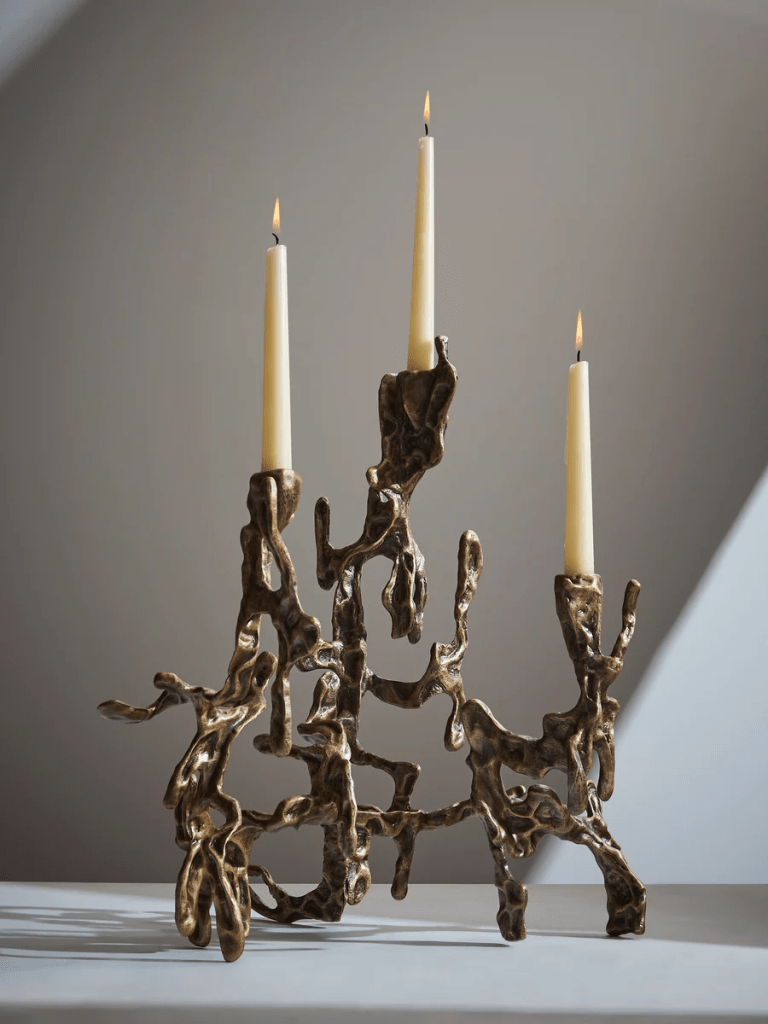
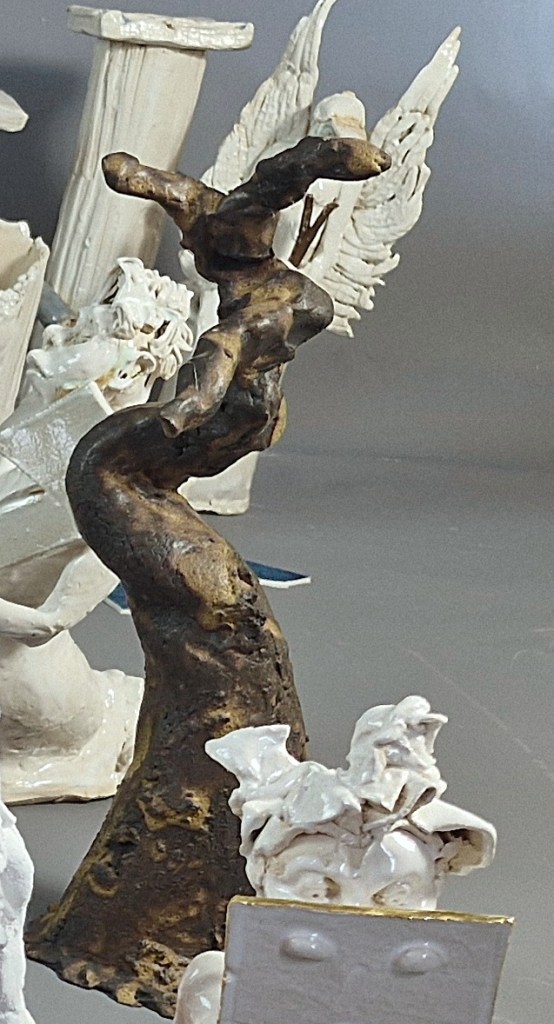
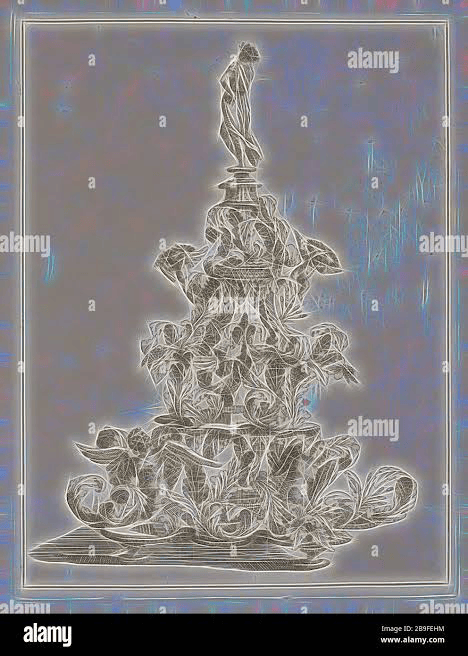
The classic Surtout arrangement which I am following has a candelabra at the centre. Rather than creating a classic Greek style candle holder with nymphs holding candles I have decided to go for a more organic look which will be in direct contrast but compatible with my dystopian world. The dystopian world already has two gnarled brown trees in it so the woody candelabra should sit nicely with that. This candelabra which is a lot like my two existing trees is an inspiration.
What the trees and the tree candelabra represent
Metamorphosis: Twisted, bent wood represents mortals transformed into tree such as Daphne or Myrrha or even the Dryads who were not turned into trees but where in fact minor goddesses in the form of trees,
Promethean Fire vs. The Wilderness: Candelabras represent enlightenment, sacrifice, and the Promethean gift of fire. Placing fire on top of a woody tree-like base highlights the tension between the wild natural order and the unrestrained soak or human ambition.
The Sacred Grove: Wood was central to ancient Greek religious practice. It was the material used for creating early statues (xoana), whilst trees marked the boundaries of sacred groves where mortals communicated with deities.
Cracked Myth Surtout
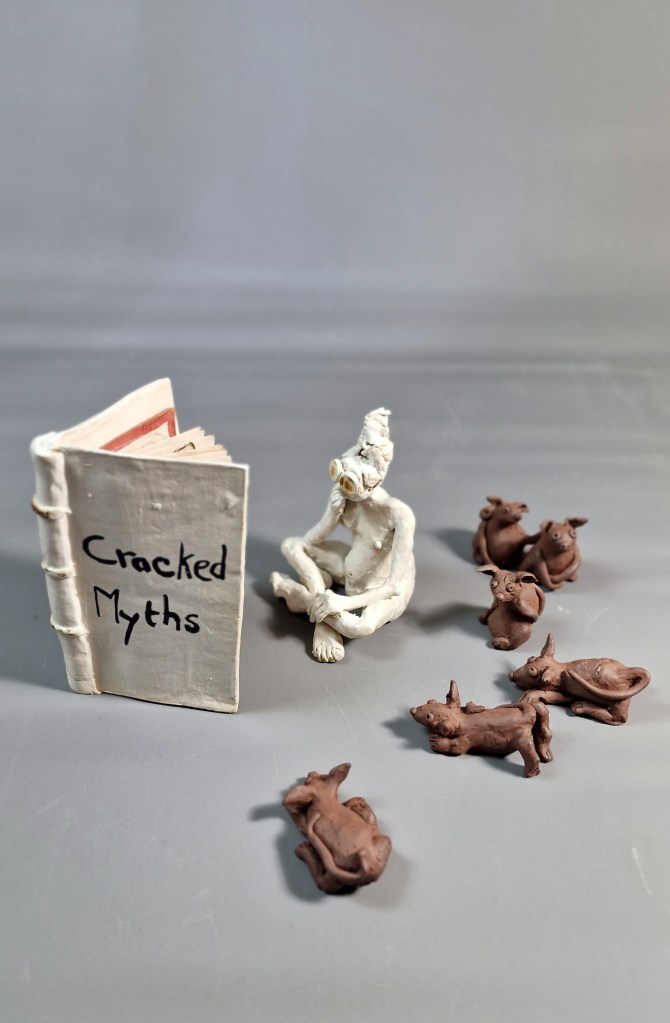
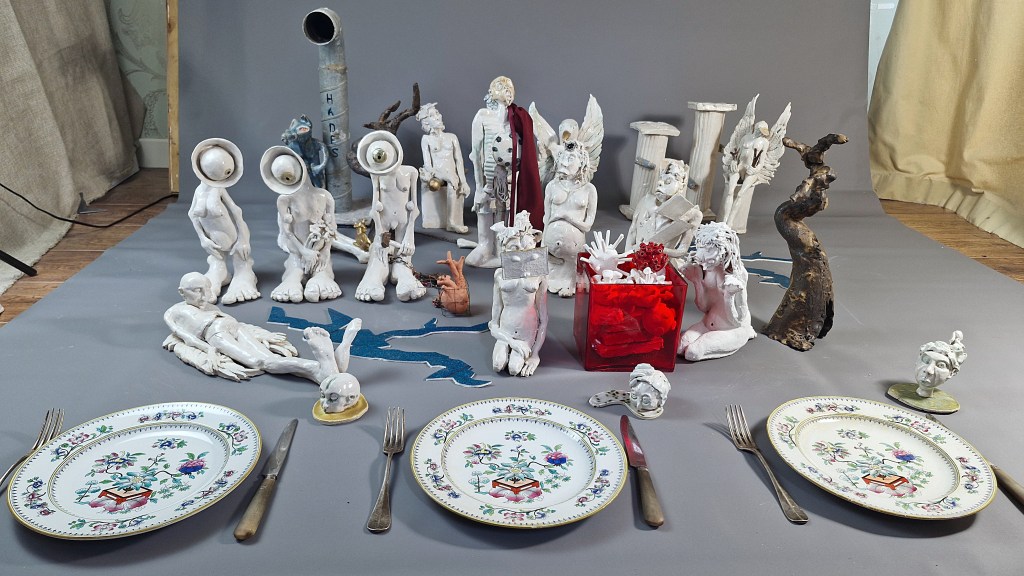
This is the look I am aiming for with many more gods, goddesses and monsters and a candelabra in the middle. The artist Oska Lappin will be providing the hand built and decorated plates. Here is an early example before adding of colour and final iring.
I am also planning to work with my friend, and fellow potter Oska Lappin, to create a surtout display on a dining table size space with plates and cutlery. I am proving the ceramic display and she will provide the beautiful decorated plates echoing the theme of the exhibition.
A ceramic surtout de table or a very grand dining centrepiece usually features a mirrored plate framed by ceramic figures, candelabra and tazzas. The ceramic installation functions as the focal point of a table setting, visually elevating candlelight and floral arrangements. It will be interesting visually to follow these conceits, as I am already aware that the addition of the dining plates to the Cracked Myths figures has made the view considerable more attractive. So tazzas and candelabra it is – my to do list grows ever longer…
A Tazza is a shallow bowl suspended on a decorative support.
Surtout Display Techniques
To exhibit ceramics in the spirit of a traditional surtout de table, artists and curators employ specific display elements:
Reflective Platters: Using mirrored glass, polished metal, or gilded bronze bases to reflect the undersides and intricate glazing of the ceramic objects.
Tiered Platforms: Staging vessels and sculptures at varying heights to create architectural depth, echoing historical multi-part centerpieces.
Modular Groupings: Arranging dozens of individual, hand-crafted objects to flow across the surface, treating the entire table as an interconnected installation.
Description, history and modern art usage
A surtout de table is a grand, decorative centrepiece placed on formal dining tables. Bouke de Vries dramatically modernizes this historic tradition by using shattered porcelain, antique shards, and plastic elements to create complex narratives on the tabletop. The history of the surtout de table ranges from ancient confectionery architecture to modern art installations.
The surtout de table is said to have first appeared in 1692 at the meals for the wedding of Philippe II, Duke of Orléans and Louis XIV’s legitimized daughter Françoise Marie de Bourbon, as “a great silver gilt piece of a new invention”. At first it was designed to hold candles, condiments, and other clutter on the table, and protect a polished wooden table from the staining caused by spillage from the salt and vinegars in the condiments. During the first half of the 18th century as the sugar sculpturetrionfo declined, the surtout de table evolved to fill its role.
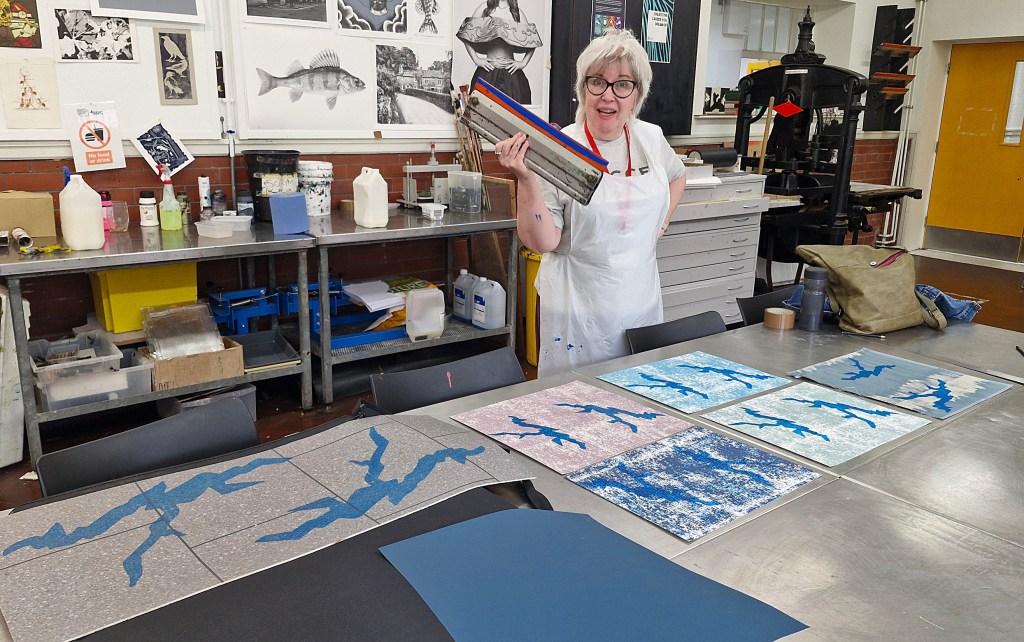
I am making screen printed cracks in lino to create a look of a crumbling earth surface for my Cracked Myths world. The lovely people in Blackpool School of Arts, Brendan Shaw and Paula Smithson helped me make these. The cracks are mainly printed onto linoleum so they are sturdy for exhibition purposes, others we did on paper and textile to experiment with the process. Thats me posing for the camera in the print room.
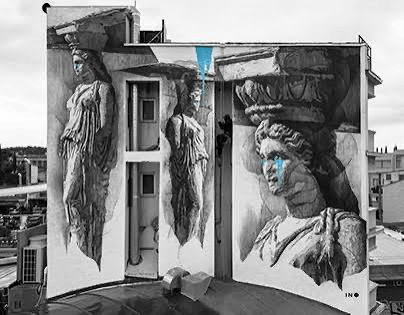
Athens uses its walls for political protest, economic commentary, and modern storytelling. The districts most famous for graffiti are Psyrri, Exarchia and Monastiraki (Ermou Street). The famous 2023 mural Caryatids Crying by the artist INO is in Ermou Street. Here you can see the famous Ancient Greek figures weeping about the state of modern Greek politics and culture. This is most definitely a modern example of a cracked myth. The Caryatids are the daughters of Athens.
Originals
INO’s murals
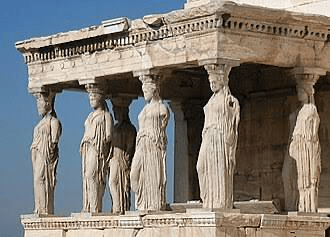
But who were the Caryatids?
These six sculpted female figures replaced traditional stone pillars to support the Erechtheion temple on the Acropolis. Carved from marble in420 BC. The popular legend suggest that these figures represent women of Caryae. The town betrayed Greece by forming an allegiance with Persia and as a punishment, the men were killed, the women enslaved forced to forever carry heavy loads.
And what is their significance to modern Greece?
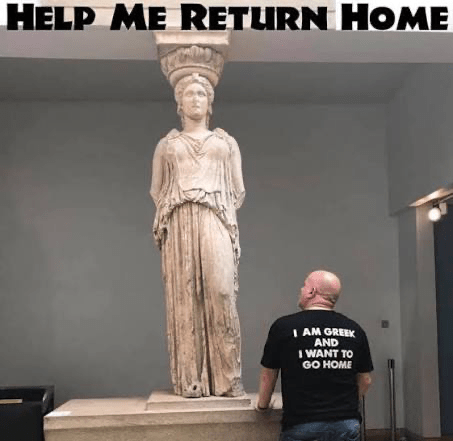
Cultural Restitution In the early 19th century Lord Elgin removed one of the sisters who now sits all alone in the British Museum, London. In the early 19th century, Lord Elgin removed one of the six original sisters. Today, that statue sits in the British Museum in London, whilst her five siblings reside in the climate-controlled Acropolis Museum in Athens. Their separation is a metaphor for the returned of contested historical artefacts. It is a story we are not often told in the UK.
State Identity and Heritage The Caryatid represent an important sense of what it is to be Greek and strength in a time of adversity. They remind the modern public of an unbroken link between ancient ideals and contemporary society – and are a powerful link to my own artistic work Cracked Myths
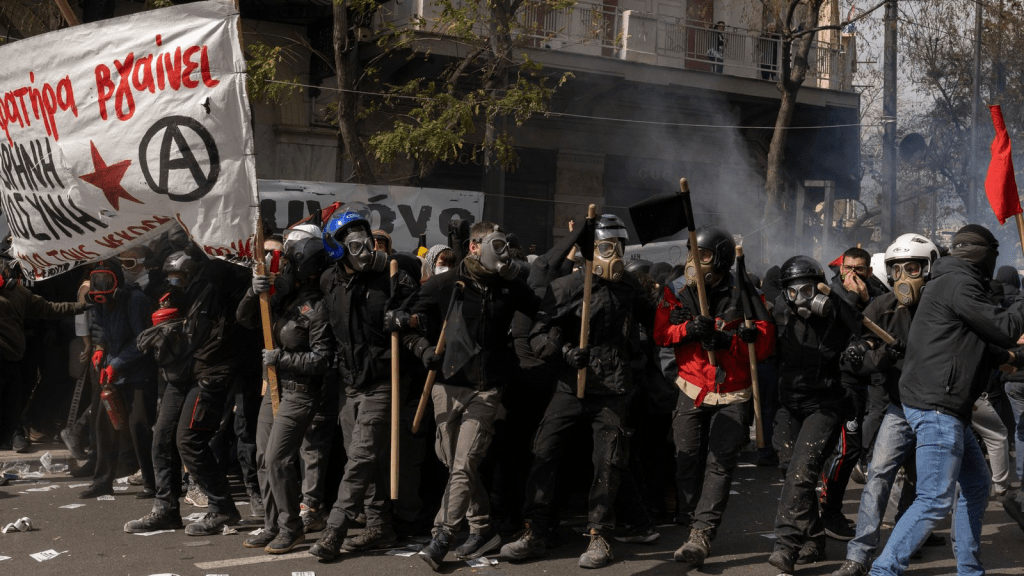
The beautiful Greek capital city Athens has had a troubled past and this continues to the present day. There is currently 16.8% youth unemployment, older workers are finding their jobs are being outsourced to cheap labour from other countries whilst the rich get richer. The richest 10% of people own about four times as much wealth as the poorest 50% combined. These richest 10% of the country get their income from real estate and shipping. There are 82,000 millionaires in Greece and 9910 high net worth people with an income of $30,000
But behind the current economic situation, which is a distinct improvement from the financial crisis of 2013, there is bitter bedrock of misgivings:
Kileler uprising, 1910 mass farmer protests against extended privileges of landowners and the limitation of their own rights in Kileler
Anti-austerity movement in Greece, 2010–2012 series of demonstrations and general strikes sparked by plans to cut public spending and raise taxes
Athens Polytechnic uprising, 1973 massive demonstration of popular rejection of the Greek military junta of 1967–1974
2008 Greek riots, large protests and demonstrations that escalated to widespread rioting, starting in Athens and spreading to other cities.
2021 Greek protests, demonstrations against a proposed government bill that would allow police presence on university campuses, without the approval of the university’s council or as a response to a felony, for the first time in decades.
In my work I explore themes of consumer culture, environmental recklessness, and socio-political global conflict in ceramic. In my last work Shed Salty Tears the debris left on our beaches reveals plastic’s wider implications for our environmental health, marine ecosystems and how both marine and human populations can survive. This was a 21st century environmental dystopia.
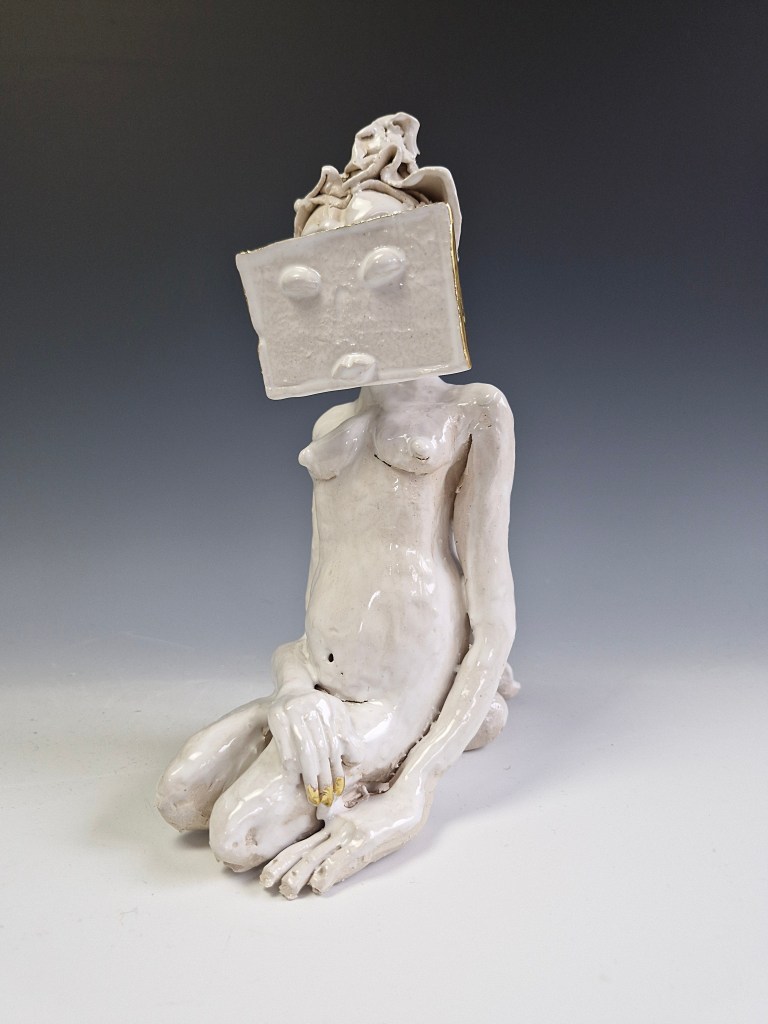
For my next work Cracked Myths I decided to look to ancient cultures to draw comparisons with our modern world and the downfall of powerful ancient civilisations. I also draw connections between dystopia and modern surveillance society. Modern society has incorporated Surveillance culture into our daily lives with alacrity, allowing huge corporations to harvest our private date, monitoring our movements, checking our social media use and community policing.
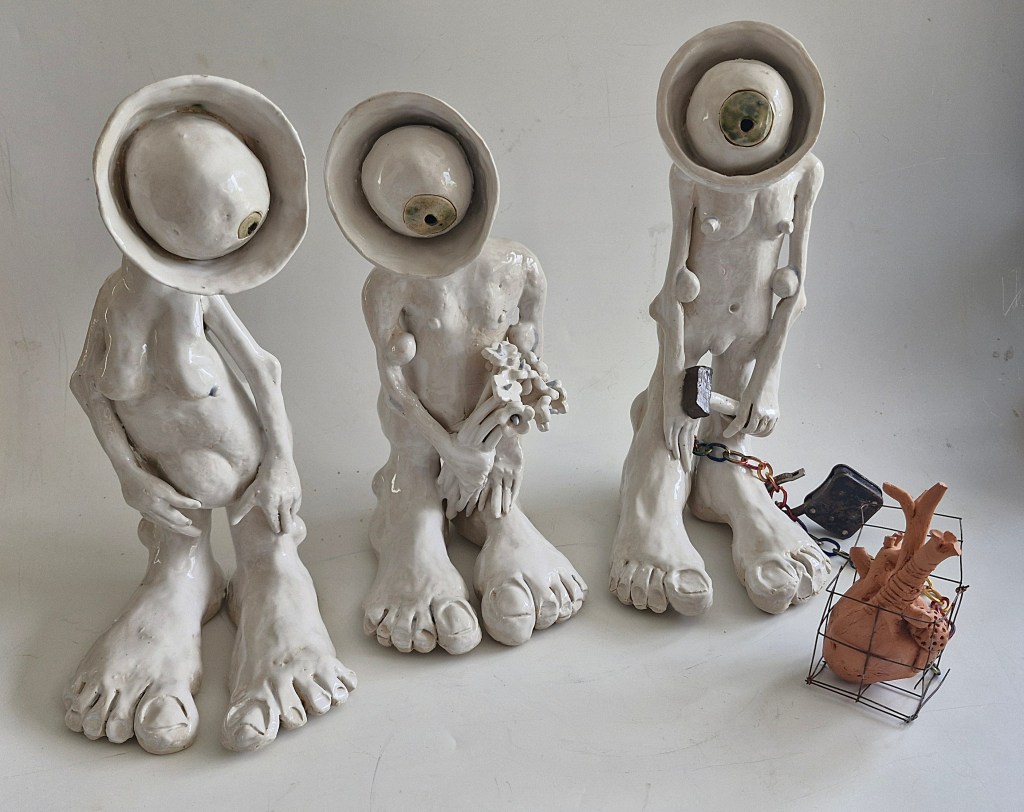
Cracked Myths, albeit set in an ancient world, comments on this. Graeco Roman pillars have surveillance cameras attached to them, the three Cyclopes have surveillance camera eyes as does the nerdy Goddess Clio with her huge spectacles reading her Cracked Myths book Clay Surveillance for more.
How to create a ceramic dystopia?
An environment of broken Roman pillars, re-imagined gods and goddess, monsters and creatures emerging from Hades is starting to appear. Structures and figures will have cracks deliberately cut into them: apart from symbolising an earthquake they will symbolise the passage of time, the fragility of humanity, and the endurance of classical art. They explore the idea that beauty is not complete without bearing traces of suffering or damage.
In contemporary art, cracked sculptures are sometimes reimagined using the Japanese kintsugi technique (repairing broken pottery with gold), highlighting the beauty of repairs.
The history of Kintsugi
Kintsugi is the ancient Japanese technique of preparing broken ceramics. The cracks and blemishes are painted with gold, silver of platinum lacquer. so, rather than disguising the cracks, they are highlighted to celebrate the history of the object and to realise the beauty in imperfection
Rooted in the Japanese philosophy of wabi-sabi (accepting transience and flaws), the Kintsugi philosophy suggests that a repaired piece is often more beautiful and unique than the original. This is a modern example produced by the artist Billie Bond.
How it is done
Traditional kintsugi uses urushi (a natural Japanese lacquer) mixed with gold, silver, or platinum. Modern methods often use accessible epoxy resin combined with gold mica powder for a similar aesthetic, or even gold paint.
Why am I using Kintsugi?
I intend that the Kintsugi will highight the effect of a damaging earthquake on human forms and buildings. I will deliberately deface some figures to symbolise the passing of time, the fragility of humanity, and the endurance of classical art. They explore the philosophical idea that beauty is not complete without celebrating scaring, suffering or damage.