In the 21st century, cracked myths or the modern mythologies that are constantly re-examined, broken down, or adapted are frequently represented by high-profile figures in technology, media, and politics elevated to legendary status in a way that parallels ancient gods. In my work I explore themes of consumer culture, environmental recklessness and surveillance in ceramic.
An environment of broken Roman pillars, re-imagined gods and goddess, monsters and creatures emerging from Hades emerges. Structures and figures have cracks deliberately cut into them: apart from symbolising an earthquake they symbolise the passage of time, the fragility of humanity, and the endurance of classical art. They explore the idea that beauty is not complete without bearing traces of suffering or damage.
Altered perspectives
The Cracked Myths installation is an ancient, yet modern, dystopia. The classical buildings are falling apart, some are covered in grafitti, the ancient gods aren’t quite what they seem and all around the cracks of a recent earthquake are showing. The ceramic gods, monsters and building are not built to scale size and this creates an altered perspective. The feeling that nothing is quite right adds to the sense of dystopia.
Ancient Myths in modern contexts
I take ancient myths and use ceramics to place them in modern contexts, exploring how the human experiences of love, death, power, grief remain relevant today. I also address issues such as feminism, queer identity, and migration, but in the process of doing this I keep being lead back to the idea of the prevalence of surveillance in our modern world. The cameras, the face recognition software and digital surveillance we come across day after day.
A surveillance society
Britain is the world’s most watched nation having 4 million cameras in use. George Orwell’s Bg Brother figure from his fictional work “Nineteen Eighty Four” comes to mind on a regular basis.The expansion and the overuse of the surveillance in Britain risks undermining the right to privacy; it poses a huge risk to individual liberty; and one more step towards a police state in the United Kingdom.
“Britain’s surveillance society can be closely linked to the works of Jeremy Bentham and Michel Foucault. In 1785, Jeremy Bentham proposed the idea of the Panopticon: the Panopticon is a conceptual prison design that allows the prison guard to watch the prisoners without the prisoners being able to tell when they are being watched, in order to gain significant psychological control. Bentham described the Panopticon as “a new mode of obtaining power of mind over mind, in a quantity hitherto without example”. https://www.adamsmith.org/blog/liberty-justice/the-rise-of-the-surveillance-society
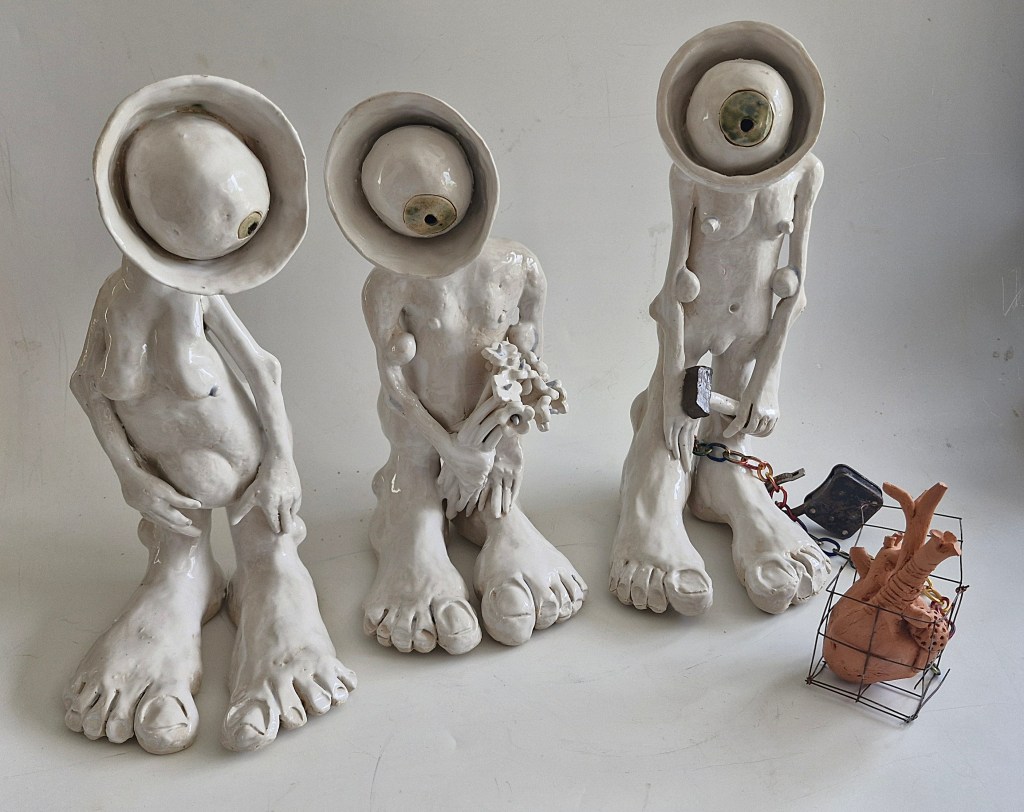
I explore this in Cracked Myths using the motif of the surveillance camera which you will find in:
1. the single eyes of the Cyclopes trio,
2. surveillance cameras attached to the destroyed Graceo Roman pillars,
3. the massive screen advertising the digital deity Small Screen Goddess attached to a pillar.
THE ARTIST
Birnbaum’s work has featured in many exhibitions including Shed Salty Tears which was exhibited during the Venice Biennale, 2025, at the ‘Art for the Planet’ exhibition. Shed Salty Tears was one of only three UK artworks chosen and category winner of the UNESCO Under the sea 2026 exhibition. TERRA FIRMA Leaky Boat was shown at Cop26 in Glasgow in 2021 and later that year in the Glastonbury Festival Arts Science tent. In 2023 the National Grid used images of the work in a ground-breaking report about the impact of climate change. Other notable exhibitions include the Gordon Pathology Museum, Guy’s Hospital London; the ARB Gallery Cambridge; the World Museum, Liverpool and ARTBOX Basel, Switzerland. She has also exhibited twice in Athens and once in Sao Paulo Brazil at the Natura exhibition.
Helen Birnbaum approaches society, and science, in a questioning way and the starting point of much of her work is contemporary society’s relationship with world changing events. However, knowing these things does not necessarily mean that we act on them, so it is up to artists to draw our attention to these concerns. The aim of Birnbaum’s work has always been to communicate these ideas in the most accessible, and even, humorous way possible. She explores different materials, whilst engaging viewers in a conversation about the crises that face the world. Themes of consumer culture, environmental recklessness, and surveillance are explored in compelling ceramic installations. She wants people to notice what she is saying.
Her art is influenced by the unique style of Pop Art which uses bold primary colours, repetition of forms and has a social critique at the heart of its message. This echoes the materials she uses. A variety of ceramic hand-building techniques are employed to create the sculptures and they often incorporate found materials such as rusty industrial metal pieces, coiled telephone wires and found objects. Recycling old metal and plastic pieces has always plays an important part in her artistic practice bringing to fruition her design ethos and whilst echoing deeper themes.

